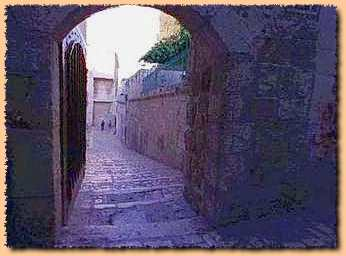
The Old Gate
The picture above is the gateway leading into the Church
of the Holy Sephulcre. The Old Gate is believed to have
been situated here.
The Old Gate, or Jeshanah Gate, was located at the northwest corner of the city during the time of Nehemiah, near the location of the present-day Holy Sepulchre (Nehemiah 3:6)
"The Jeshanah Gate was repaired by Joiada son of Paseah and Meshullam son of Besodeiah. They laid its beams and put its doors and bolts and bars in place.
And next to them Melatiah the Gibeonite, Jadon the Meronothite, the men of Gibeon and Mizpah, repaired the residence of the governor of the region beyond the River. Next to him Uzziel the son of Harhaiah, one of the goldsmiths, made repairs. Also next to him Hananiah, one of the perfumers, made repairs; and they fortified Jerusalem as far as the Broad Wall. And next to them Rephaiah the son of Hur, leader of half the district of Jerusalem, made repairs. Next to them Jedaiah the son of Harumaph made repairs in front of his house. And next to him Hattush the son of Hashabniah made repairs. Malchijah the son of Harim and Hashub the son of Pahath-Moab repaired another section, as well as the Tower of the Ovens. And next to him was Shallum the son of Hallohesh, leader of half the district of Jerusalem; he and his daughters made repairs."
Nehemiah 3:6-12 (NKJV)
The word "jeshanah" means "old". The elders of the city would meet at the gate to discuss matters of community importance and issue judgement on disputes (Joshua 20:4; Ruth 4:11; Proverbs 31:23). This gate represents both the eldership of the city (the leaders of the Body) and their guidance in the "ancient paths" of God (Jeremiah 6:16) in spiritual growth.
The meaning of the names of those directly involved in the rebuilding of this gate are significant and reveal the aspects of God's 'logos' Word. Joiada means 'Jehovah known' and shows that God's Word is His intention, His knowledge that we can know. Paseah means 'to leap and skip for joy and shows the great joy that there is in knowing and living in God's general Word. Meshullam means 'allied' or 'friend' showing our relationship with God as we keep His Word. Besodeiah means 'counsel of Jehovah' showing that God's Word gives His perfect counsel and guidance.
Another possible meaning of Jeshanah in Hebrew is "storage", therefore this gate represents the fact that we need to study the Word of God and "store away" as much as we can while we are in this early, joyful, hungry stage of our Christian lives! The Old gate speaks to us of the old ways of truth. A young Christian having experienced the sheep gate, then the fish gate soon sees the need for experiencing the old gate. This means learning the old ways of truth that never change. Jeremiah 6:16 states
'Thus says the Lord, Stand by the ways and see and ask for the ancient paths, where the good way is and walk in it; And you will find rest for your souls.'
This gate represents our coming into the truths of the Logos - the written Word of God. Later, we will see that the Water Gate represents the Rhema - the quickened, spoken, prophetic word of God. After being born again (Sheep Gate) and excitedly reaching out to the Lost (Fish Gate), we must enter into the eternal, ancient truths of God's written Word. We must see the importance of obedience, tithing, baptism, daily devotions and all that is revealed in His general will, His written Word. We learn these by sitting at the feet of anointed teachers of God's Word and studying the Word dilligently for ourselves.
The Old Gate was the pivotal corner gate. It is now called the 'Corner Gate' which is the entry of for the old paths (2 Kings 14:13; Jeremiah 31:38), located at the northwest corner of the city. Some students identify this with the "Mishneh Gate". The Hebrew word means "second quarter" or "new quarter" (Zephaniah 1:10, NIV). In Nehemiah's day, the northwest section of the city was "The Mishneh" or "New Quarter"; and this gate led into it. What a paradox: the old gate leads into the new quarter! But it is from the old that we derive the new; and if we abandon the old, there can be nothing new (see Jeremiah 6:16 and Matthew 13:52). It was through this gate that Jesus was led out to the cross where he died in our place for ours sins. It led from the old into the new but was all based on the old.
Once we have entered through the sheep gate and the gate of witness then there must be subjection to the old paths that were from the beginning. It is the gate of Lordship. God's Word represents the old paths we are to seek. Christ is the Corner stone and head of the corner (see 1 Peter 2:4-10) why not the corner gate as well.
The builders after the 'Fish Gate' represent those involved in basic discipleship and followup. Those after the Old Gate represent those involved in more detailed teachings of God's Word. The two initial repairers after the Old Gate were Melatiah and Jadon. These two names mean 'Jehovah sets free' and 'Jehovah judges', beautifully outlining the two basic sides of the ministry of teaching God's Word - setting the people free and judging the thoughts and intentions, leading to repentance and restoration.
Let's look at some basic points about the other 'repairers' after the Old Gate...
a. Of interest, two men are picked out as rebuilders of the Jeshanah Gate: Uzziel, the goldsmith, and Hananiah, the perfume-maker (see 1 Peter 1:6-7; 2 Corinthians 2:14-15). Pastoral elders are the goldsmiths and perfume-makers of the Body! They seemed not to be trained for the work of building, but they willingly gave their service. The most important ability in the work of the Lord is availability; the one with few gifts, with little talent, who has a passion and a drive to see God's work done will accomplish far more than a gifted and talented person who doesn't have they passion and drive to do the Lord's work.
b. The Broad Wall: you can go to Jerusalem today and see the remains of this Broad Wall - and broad it is, more than twenty feet wide! Critics had denied the accuracy of Bible history like this, but the archaeologist's shovel constantly confirms the truth of the Bible. This speaks of building the 'broad', general truths of the Word of God into us through studying the Bible.
c. Rephaiah the son of Hur, leader of half the district of Jerusalem worked on this section of the wall; here is another leader who knew real leadership is getting down and doing it - being a servant, instead of expecting others to do it for you. His name means 'cured' - through teaching and doing the Word of God we will be cured in our souls.
d. Jedaiah the son of Harumaph made repairs in front of his house: five times in the chapter, it speaks of those who worked on the section right in front of their house. Often, we need to give attention to the work of teaching God's Word right at our own homes. If the work needs to be done anywhere, it needs to be done at our homes!
i. The names of the men who are said to have made repairs in front of his house are interesting:
(3:10) Jedaiah means: "he who calls unto God"; our homes must be places of prayer, where the family calls unto God.
(3:23) Benjamin means: "son of my right hand," speaking of a protector; our homes must be places of protection and peace.
(3:29) Zadok means: "justice"; our homes must be places of justice and integrity, especially with integrity regarding our marital vows and promises.
(3:30) Meshullam means: "devoted"; our homes must be places of devotion and separation to God.
e. Malchijah son of Harim of is mentioned as one of the builders. His name means 'appointed' by God for this service. Those who teach God's Word must be appointed by God and not self-chosen (See Hebrews 5:4)
He is seen in Ezra 10:31 as one of the men who was confronted by Ezra for the sin of taking on a pagan wife; Malchijah got things right with God and now, years later, is serving Him!
i. A believer should never let a past failure get in the way of serving God. Repent, set it right, make a stand for righteousness - and get on serving the Lord!
f. Shallum the son of Hallohesh . . . he and his daughters made repairs: everyone who could helped in the repairs!
i. With the great number of different people working on the walls, it was imperative that they all work with the same mind - or the wall would not be uniform, and would not be a strong defense. Yet, each section would be a little different because different people were working on each section
ii. In the same way, in the family of God, the work must be done with a common vision and mindset - the mind of Christ, as Paul puts it in 1 Corinthians 2:16. When believers work together in one accord, yet with each offering their distinctive gifts, the work of God gets done in a glorious way.
Conclusion:
After being born again (Sheep Gate) and excitedly sharing Jesus with others (Fish Gate) we need to be grounded in God's Word. This is His Logos, written Word that is from of old (Old Gate). We do this by sitting at the feet of anointed teachers of His Word and studying the Bible ourselves. This process will go on for some time and we will mature and experience the joy of knowing Him more.
However, some time you will encounter the next gate - The Valley Gate.