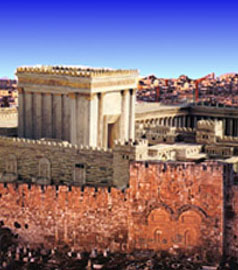
The Temple
A building in which a god (or gods) is worshiped. The Old Testament describes temples as some of man's oldest buildings. The Tower of Babel <Gen. 11:4> is the first recorded example of a structure that implies the existence of a temple, although this tower was not a temple itself. A temple was thought of as the building where the god manifested his presence, so the place the temple occupied was holy, or sacred. Because the god was thought to dwell in the temple, the Old Testament had no specific word for temple. It refers instead to the "house" of a deity.
Abraham was from Mesopotamia, where each city had a temple for its patron god. The Mesopotamians believed that the god owned their land, that the king was the vassal of the god, and that the land had to be blessed by the god in order to be fruitful. Their religious practices were, in part, designed to win the god's favor.
Several Canaanite temples are mentioned in the Old Testament. They include the temples of the god Berith in Shechem <Judg. 9:46>, Dagon in Ashdod <Judg. 16:23-30; 1 Sam. 5:2-5; 1 Chr. 10:10>, and Beth Shan on Mount Gilboa <1 Sam. 31:12>.
Because they were wandering herdsmen, the patriarchs such as Abraham and Jacob did not build temples. However, they did have shrines and altars in places where God had revealed Himself to them, such as by the oak of Moreh <Gen. 12:6-7; 33:20>, at Bethel <Gen. 12:8; 28:18-22>, and at Beersheba <Gen. 21:33; 26:23-25>.
Even after Solomon's Temple was completed, rival sanctuaries at Bethel and Dan <1 Kin. 12:28-33> competed with it. Later the Samaritans had a temple on Mount Gerizim <John 4:20>. A Judeo-Aramaic colony founded a temple at Elephantine in Upper Egypt. According to the Jewish historian Josephus, Ptolomy Vl Philometor (181-145 B. C.) granted Jewish refugees in Egypt the use of an ancient temple in the delta region.
Solomon's Temple. Once the land was fully conquered and all the tribes were properly settled, it was important that the worship of God be centralized. Because he was a man of war, David was not allowed to build the temple, but he was allowed to gather the materials for it and to organize the project <1 Chr. 22:1-19>. The actual work began "in the four hundred and eightieth year after the children of Israel had come out of the land of Egypt, in the fourth year of Solomon's reign over Israel" <1 Kin. 6:1>. Solomon began to reign about 971 B. C., so his fourth year would have been about 967 B. C. The temple was completed about 960 B. C., seven years later <1 Kin. 6:37-38>.
In biblical times three temples were built on the same site: Solomon's, Zerubbabel's, and Herod's. Solomon built the temple on the east side of Jerusalem on Mount Moriah, "where the Lord had appeared to his father David, at the place that David had prepared on the threshing floor of Ornan the Jebusite" <1 Chr. 21:28; 2 Chr. 3:1>. The highest part of Mount Moriah is now the site of the building called The Dome of the Rock in Jerusalem.
Solomon contacted Hiram, king of Tyre, to supply workmen and materials to help construct the Temple <2 Chr. 2:3>. <First Kings 5:6> calls those workmen Sidonians. Additionally, Solomon "raised up a labor force out of all Israel" of 30,000 men to assist Hiram in the forests of Lebanon <1 Kin. 5:13>. According to <1 Kings 5:15>, "Solomon had seventy thousand who carried burdens, and eighty thousand who quarried stone in the mountains." The Gebalites also helped to quarry stones <1 Kin. 5:18>. Those who quarried stones were overseen by 3,300 of Solomon's deputies <1 Kin. 5:16>.
Solomon's Temple is described, though incompletely, in <1 Kings 6--7> and in <2 Chronicles 3--4>. The description of Ezekiel's Temple <Ezek. 40-43>, an elaborate version of Solomon's, may supplement those accounts. Solomon's Temple was in the shape of a rectangle that ran east and west. Like Ezekiel's Temple <Ezek. 41:8>, it may have stood on a platform. The accounts in Kings and Chronicles suggest that there was an inner and an outer courtyard.
Three main objects were situated in the inner courtyard. The bronze altar that was used for burnt offerings <1 Kin. 8:22,64; 9:25> measured 20 cubits square and 10 cubits high <2 Chr. 4:1>. Between that and the porch of the Temple stood the bronze laver, or molten sea, that held water for the ritual washings <1 Kin. 7:23-26>. It was completely round, 5 cubits high, 10 cubits in diameter, and 30 cubits around its outer circumference <1 Kin. 7:23>. Twelve bronze oxen, in four groups of three, faced outward toward the four points of the compass, with the bronze laver resting on their backs <1 Kin. 7:25>; (Ahaz removed the bronze laver from the oxen; <2 Kin. 16:17>).
Finally, at the dedication of the Temple, Solomon is said to have stood on a "bronze platform five cubits long, five cubits wide, and three cubits high" that stood in the middle of the courtyard <2 Chr. 6:12-13>.
The interior dimensions of the Temple were 60 cubits long, 20 cubits wide, and 30 cubits high <1 Kin. 6:2>. The ten steps to the porch of the Temple were flanked by two bronze columns, Jachin and Boaz, each 25 cubits high (including the capitals) and 12 cubits in circumference <1 Kin. 7:15-16; 2 Chr. 3:15>. The porch was 10 cubits long, 20 cubits wide, and, supposedly, 120 cubits high <2 Chr. 3:4>. But since the rest of the building was only 30 cubits high, some scholars question this figure of 120 cubits.
To the west of the porch was the Holy Place, a room 40 cubits long, 20 cubits wide, and 30 cubits high where ordinary rituals took place. Windows near the ceiling provided light. In the Holy Place were the golden incense altar, the table for the showbread, five pair of lampstands, and the utensils used for sacrifice. Double doors, probably opened once a year for the high priest on the Day of Atonement, led from the west end of the Holy Place to the Holy of Holies, a 20-cubit cube. In that room two wooden cherubim, each ten feet tall, stood with outstretched wings. Two of the wings met above the ark of the covenant and two of them touched the north and south walls of the room <1 Kin. 6:27>. God's presence was manifested in the Holy of Holies as a cloud <1 Kin. 8:10-11>.
The outside of the Temple building, excluding the porch area, consisted of side chambers, or galleries, that rose three stories high <1 Kin. 6:5>. The rooms of the Temple were paneled with cedar, the floor was cypress, and the ornately carved doors and walls were overlaid with gold <1 Kin. 6:20-22>. Not a stone could be seen.
Shishak, king of Egypt, took away the Temple treasures during the reign of Rehoboam, Solomon's son <1 Kin. 14:26>. Asa used the Temple treasure to buy an ally <1 Kin. 15:18> and to buy off an invader <2 Kin. 16:8>. Manasseh placed Canaanite altars and a carved image of Asherah, a Canaanite goddess, in the Temple <2 Kin. 21:4,7>. Ahaz introduced an altar patterned after one he saw in Damascus <2 Kin. 16:10-16>. By about 640 B. C., Josiah had to repair the Temple <2 Kin. 22:3-7>. After robbing the Temple of its treasures and gold during his first attack <2 Kin. 24:13>, in 587 B. C. the Babylonian King Nebuchadnezzar looted, sacked and burned the Temple <2 Kin. 25:9,13-17>, but people still came to the site to offer sacrifice <Jer. 41:5>.
Ezekiel's Temple. Ezekiel's vision of a future Temple <Ezekiel 40--43> comforted the Jewish captives in Babylon <Psalm 137> who remembered the glory of Solomon's Temple and its destruction by the Babylonians. The Temple in Ezekiel's vision differs little in its physical configuration and dimensions from Solomon's.
The Second Temple. Cyrus, king of Persia, authorized the return of the Jewish captives, the return of the Temple vessels Nebuchadnezzar had looted, and the reconstruction of the Temple (about 537 B. C.), which was finished about 515 B. C. The completed Temple was smaller than and inferior to Solomon's <Ezra 3:12>. The ark of the covenant was never recovered, and so the Second Temple (and Herod's Temple) had no ark. Neither were Solomon's ten lampstands recovered. One sevenbranched candelabrum, the table of showbread, and the incense altar stood in the Holy Place of the second Temple (as they did in Herod's Temple), but these were taken by Antiochus IV Epiphanes (about 175-163 B. C.), who defiled the altar in 167 B. C. The Maccabees cleansed the Temple, restored its furnishings (164 B. C.; <1 Macc. 4:36-59>), and later turned it into a fortress.
Herod's Temple. King Herod, an Idumean, sought to appease his Jewish subjects by constructing an enormous, ornate, cream-colored Temple of stone and gold that began in 19 B. C. The main building was finished by 9 B. C., but the entire structure was not completed until A. D. 64. The Romans destroyed it in A. D. 70. The gold and white stone shone so brightly in the sun that it was difficult to look directly at the Temple.
The Temple building occupied an area that measured about 446 meters (490 yards) from north to south and 296 meters (325 yards) from east to west. The entire Temple complex was enclosed by a massive stone wall, the southeast corner of which stood about 45 meters (50 yards) above the floor of the Kidron ravine. The parapet above this corner may have been the "pinnacle of the temple" referred to in the gospels <Matt. 4:5>. There was one gate in the north wall, one in the east wall, two in the south wall, and four in the west wall facing the city.
The Fortress of Antonia, the Jerusalem residence of the Roman procurators, stood at the northwest corner of the complex. The fortress housed a Roman garrison <Acts 21:31> and, as a symbol of submission, the robes of the High Priest.
Double porticos, 30 cubits wide and supported by shining marble columns 25 cubits high, were constructed along the inside of the main walls, surrounding the outer court of the Temple, the Court of the Gentiles. Including the Tower of Antonia, these porticos were about 11,800 meters (3,600 feet) in circumference. The Royal Porch, along the south wall, had four rows of columns. Solomon's Porch, located along the east wall, had two rows of columns <John 10:23; Acts 3:11; 5:12>. This was the place where the scribes had their debates <Mark 11:27; Luke 2:46; 19:47> and where the merchants and moneychangers transacted business <Luke 19:45-46; John 2:14-16>.
Inside of and slightly higher than the outer court (the Court of the Gentiles) was a smaller enclosure surrounded by a ballustrade three cubits high. This enclosure was posted with recurring notices in Greek and Latin that any Gentile who entered the inner area was subject to death. After passing through one of several openings in the ballustrade, 14 steps led up to the inner area, which was surrounded by a wall 25 cubits high. This wall was separated from the steps by a terrace 10 cubits wide. Flights of five steps led from the terrace to eight gates in the wall, four on the north and four on the south side.
The inner area of Herod's Temple contained three courts. The easternmost court was the Court of Women, and it contained the Temple treasury where people donated their money <Mark 12:41-44>. Three gates led into this court, one on the north, one on the south, and a third on the east. This third gate was probably the "Beautiful Gate" <Acts 3:2,10>. A fourth, larger, more massive and ornate gate led from the Court of the Women west into the Court of Israel (for male Jews), which was elevated 15 steps above the Court of Women.
Inside the Court of Israel was the innermost court, the Court of the Priests. During the Feast of Tabernacles, men could enter the Priest's Court to walk around the altar. The Court of Priests immediately surrounds the Temple building itself (the Holy Place and the Holy of Holies) and the altar of burnt offering.
The layout of Herod's Temple was patterned after Solomon's. The two-story temple building was in the shape of a "T." The porch of the building (the cross member of the "T") was a vestibule 100 cubits long and 100 cubits high, with an opening 70 cubits high and 25 cubits wide. In front of the porch at the foot of the steps, surrounded by a cubit-high stone barrier, was the altar of burnt offering (15 cubits high and 50 cubits square). At the back of the vestibule were the main double doors (16 cubits wide and 55 cubits high) that led into the Holy Place.
The Holy Place was 40 cubits long, 20 cubits wide, and 60 cubits high. It contained the table of showbread, the seven-branched lampstand, and the altar of incense. The Holy Place was divided from the Holy of Holies by a curtain that stretched from floor to ceiling <Matt. 27:51; Mark 15:38; 2 Cor. 3:14>. The Holy of Holies was 20 cubits by 20 cubits by 60 cubits high. It contained no furniture. The temple was surrounded on the north, south, and west sides by three stories of rooms that rose 60 cubits.
Temple in the New Testament. The New Testament uses two words for Temple. One of these words refers to the collection of buildings that made up the Temple in Jerusalem, while the other usually refers to the sanctuary of the Temple.
Jesus related to the Temple in four distinct ways. First, as a pious Jew who was zealous for the Lord Jesus showed respect for the Temple. He referred to it as "the house of God" <Matt. 12:4> and "My Father's house" <John 2:16>. He taught that everything in it was holy because of the sanctifying presence of God <Matt. 23:17,21>.
Second, Jesus' zeal led Him to purge the Temple of the moneychangers <Mark 11:15-17; John 2:16> and to weep over it as He reflected on its coming destruction <Mark 13:1; Luke 19:41-44>. Because <Malachi 3:1> prophesied the cleansing of the Temple as something the Lord and His Messenger would do, Jesus' act implied His deity and messiahship. Consequently, the hard-hearted scribes and chief priests "sought how they might destroy Him" <Mark 11:18; Luke 19:47>.
Third, because He was the Son of God incarnate, Jesus taught that He was greater than the Temple <Matt. 12:6>. Jesus' teaching that if the temple of His body was destroyed in three days He would raise it up <John 2:19> likewise affirms His superiority to the Temple building. That saying of Jesus may have provided the basis for the claim of the two false witnesses at His trial who stated that Jesus said, "I am able to destroy the temple of God and to build it in three days" <Matt. 26:60-61; 27:40; Mark 14:57-58; 15:29>.
Finally, Jesus taught that the church <Matt. 16:18> is the new, eschatological temple <Matt. 18:19-20; John 14:23>.
At the moment of Jesus' death, the veil of the Temple was torn from top to bottom <Matt. 27:51; Mark 15:38; Luke 23:45>. By His death, Jesus opened a new way into the presence of God. A new order replaced the old. No longer was the Temple in Jerusalem to be the place where men worshiped God. From now on they would worship Him "in spirit and truth" <John 4:21-24>.
The first Christians were converted Jews. They continued to worship at the Temple as Jesus had <Luke 24:52; Acts 2:46; 3:1; 5:12,20-21,42>. As they began to understand the meaning and significance of Jesus' person, work, and teaching, they realized they were the new people of God, infused by God's Spirit. As such, they were a new, living Temple. A new order had replaced the old. Stephen, a Christian of Gentile background <Acts 6:1-5>, was the first person to understand that the church had replaced the Temple as the place where God's presence was manifested in a special way among His people.
In <Acts 15:13-18> Stephen's insight was carried forward by James, who identified the church with Amos' prophecy about the "tabernacle of David, which has fallen" <v. 16>. According to James' application of Amos' prophesy about the end times, the restoration of David's tabernacle, the Temple, would serve as the rallying point for Gentiles who wished to come to the Lord <Amos 9:11-12>. James understood the church as the new temple that fulfilled that prophecy.
According to the apostle Paul, "All the promises of God" are "Yes, and... Amen" in Christ <2 Cor. 1:20>. Ezekiel and other prophets had prophesied a new temple <Ezekiel 40--43>, and Paul understood the church as the fulfillment of those prophesies. Individually the Christian's body is "the temple of the Holy Spirit" <1 Cor. 6:19>. Corporately the church is "the temple of God" where the Spirit of God dwells <1 Cor. 3:16; 2 Cor. 6:16>. Christians are growing "into a holy temple in the Lord... a dwelling place of God in the Spirit" <Eph. 2:21-22>. Because we are God's new temple where the Holy Spirit dwells, Christians are to be holy <1 Cor. 6:18-20; 2 Cor. 7:1>.
Because God dwells in us, Christians are holy to God, and He will destroy anyone who defiles us <1 Cor. 3:16-17>. Because there is only one new temple and all Christians-- regardless of race or religious background-- are members of it, all Christians have equal access to God <Eph. 2:19-22>. Paul understood the church, then, as the eschatological temple to which God is gathering Israel and the other nations of the world <Is. 2:2-4; Mic. 4:1-5>.
Paul used the metaphor of the temple to express the unity of the new people of God that God is bringing about through the preaching of the gospel. The members of this new race are Jews and Gentiles who formerly were separated by the "middle wall of separation" and the "ordinances" that forbade them to mix <Eph. 2:14-15>. Christ's sacrificial death on the cross ushered in a new age in God's relationship with mankind and abolished the enmity between Jew and Gentile by abolishing the validity of the ordinances that gave expression to it <v. 15>. He abolished those ordinances in order to create "one new man," a new race composed of Jewish and Gentile Christians at peace with one another <v. 15, 17>. This "new man" is a living temple <v. 21> that is based on the teaching of the New Testament apostles and prophets and on the teaching, work, and person of Christ <v. 20>.
Jesus Himself is the chief cornerstone of the building and so gives it shape and character <v. 20>. The building is holy because it is growing "in the Lord" <v. 21> and because God dwells there in the Spirit <v. 22>. "Lord," "God," and "Spirit" define this new temple in a trinitarian fashion. The metaphors of God's new people being a temple ("building") and being a body ("growing") are blended in <verse 21>.
In a similar way, Peter used the word house to describe Christians as members of a new, spiritual temple <1 Pet. 2:4-10>. Christ is the chief cornerstone <v. 6>. He is "a stone of stumbling and a rock of offense" <v. 8>, a "living stone, rejected... by men, but chosen by God and precious" <v. 4>. Like Christ, Christians are "living stones" who are being built into a "spiritual house," or temple <v. 5>. The metaphor of the "spiritual house" is combined with that of the "holy priesthood" that offers "spiritual sacrifices" <v. 5>. And this "royal priesthood" of believers is a "holy nation," God's new people who proclaim His praises <vv. 9-10>, the New Israel <Ex. 19:6>.
In addition to understanding the church as the new, spiritual temple of God on earth that replaced the Temple in Jerusalem, the New Testament alludes to a heavenly temple in whose life the church participates. John <John 1:51; 14:2> and Paul <Gal. 4:26; Phil. 3:20> both allude to the heavenly temple, but the idea is most developed in Hebrews and Revelation.
The author of Hebrews was concerned to demonstrate that Christianity is better than Judaism. Among other things, Christians have a better covenant, a better sacrifice, a better high priest, and a better temple. The Temple in Jerusalem was only a "copy and shadow," a type, of the true temple, which is in heaven <Heb. 8:5>. Therefore the true, heavenly sanctuary into which Christ has entered on our behalf is better than its earthly copy <9:24>. Because Christ our High Priest dwells in this heavenly sanctuary <9:24; 10:12; 19-22>, we can enter the heavenly Holy of Holies and participate in the worship of the heavenly temple <10:19-22; 12:18-24>. The author appears to define the heavenly temple as "the general assembly and church of the firstborn" <12:23>.
According to John, the author of Revelation, there is a celestial Mount Zion <14:1; 21:10>, a heavenly Jerusalem <3:12; 21:2>, and a heavenly temple <11:19; 15:5--16:1>. Christians who overcome temptation and trials are made pillars in the heavenly temple of God <3:12>. As in Ephesians, then, the heavenly temple grows.
From this heavenly temple God will issue His judgments on the nations during the Tribulation <11:19; 14:14-20; 15:5--16:1>. The martyrs of the Tribulation will serve God "day and night in His [heavenly] temple" <7:15>. The temple in Jerusalem will be measured and judged during that time <11:1-2>.
In the New Jerusalem there will not be a temple because "the Lord God Almighty and the Lamb are its temple" <Rev. 21:22>. In that perfect city nothing will come between God and man, and we "shall see His face" <22:4>. In the new heaven and earth "the tabernacle of God" will be "with men, and He will dwell with them, and they shall be His people. God Himself will be with them and be their God" <21:3>.
Paul identified the new temple with the church, but John and the author of Hebrews identified it with the heavenly realm where Christ dwells. Furthermore, just as there was no temple before the fall, so John anticipated a new heaven and earth without a temple. These different ways of understanding the relation of the temple to the new people of God are complementary, not contradictory.
(from Nelson's Illustrated Bible Dictionary)
(Copyright (C) 1986, Thomas Nelson Publishers)