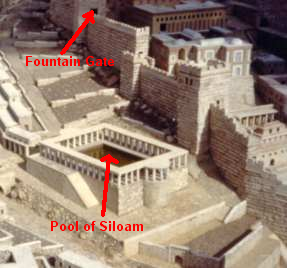
The Fountain Gate
Picture of a model of the Fountain Gate that led to the Pool of Siloam.
The Fountain Gate was located at the southeast corner of the wall (Nehemiah 3:15).
"Then I moved on toward the Fountain Gate and the King's Pool, but there was not enough room for my mount to get through"
Nehemiah 2:14.
"Shallun the son of Col-Hozeh, leader of the district of Mizpah, repaired the Fountain Gate; he built it, covered it, hung its doors with its bolts and bars, and repaired the wall of the Pool of Shelah by the King's Garden, as far as the stairs that go down from the City of David.
After him Nehemiah the son of Azbuk, leader of half the district of Beth Zur, made repairs as far as the place in front of the tombs of David, to the man-made pool, and as far as the House of the Mighty.
After him the Levites, under Rehum the son of Bani, made repairs. Next to him Hashabiah, leader of half the district of Keilah, made repairs for his district.
After him their brethren, under Bavai the son of Henadad, leader of the other half of the district of Keilah, made repairs.
And next to him Ezer the son of Jeshua, the leader of Mizpah, repaired another section in front of the Ascent to the Armory at the buttress.
After him Baruch the son of Zabbai carefully repaired the other section, from the buttress to the door of the house of Eliashib the high priest.
After him Meremoth the son of Urijah, the son of Koz, repaired another section, from the door of the house of Eliashib to the end of the house of Eliashib.
And after him the priests, the men of the plain, made repairs.
After him Benjamin and Hasshub made repairs opposite their house. After them Azariah the son of Maaseiah, the son of Ananiah, made repairs by his house. After him Binnui the son of Henadad repaired another section, from the house of Azariah to the buttress, even as far as the corner. Palal the son of Uzai made repairs opposite the buttress, and on the tower which projects from the king's upper house that was by the court of the prison. After him Pedaiah the son of Parosh made repairs."
Neh 3:15-25(NKJV)
The Fountain Gate appeared to be the gate in most ruin, so much so that it blocked Nehemiah's midnight inspection. This meant that, in the natural, the Fountain Gate must have been a centre of concentrated attack during the siege of Jerusalem by the Babylonian army (2 Kings 25:4). Likewise, this gate's spiritual counterpart is a target of concentrated Satanic attack.
The Fountain Gate was repaired by Shallun son of Col-hozeh, ruler of the district of Mizpah. He rebuilt it, roofing it over and putting its doors and bolts and bars in place. He also repaired the wall of the Pool of Siloam, by the King's Garden, as far as the steps going down from the City of David. Beyond him, Nehemiah son of Azbuk, ruler of a half-district of Beth Zur, made repairs up to a point opposite the tombs of David, as far as the artificial pool and the House of the Heroes...Next to him, Ezer son of Jeshua, ruler of Mizpah, repaired another section, from a point facing the ascent to the armoury as far as the angle" Nehemiah 3:15-19.
The Fountain Gate derived its name from the fact that it was the primary access to the Fountain - the Gihon Spring, Jerusalem's sole perennial source of water. This fountain represented the life source of God Himself (Psalm 36:9; Isaiah 8:6). Prior to the captivity, Jeremiah prophesied:
"My people have committed two sins: They have forsaken me, the spring of living water, and have dug their own cisterns, broken cisterns that cannot hold water" Jeremiah 2:13.
Of all the sins of Jerusalem, these two were singled out by God as the most severe. These two sins remain the most severe in the Church too:
1. Forsaking the spring of living water (Jeremiah 17:5-8,13).
2. Building broken cisterns (Jeremiah 14:3-4; 38:6; Genesis 37:24; Zechariah 9:11).
A cistern was like a well, built into the ground, but had no independent source of water. Water was brought from another source to the cistern, which held it in storage for later use. The Lord likens those who trust in their own resources to those who build broken cisterns - their lives leak joy, peace, faith and strength. Jesus encouraged us to come to Himself - the spring of living water (John 4:10-14).
"On the last and greatest day of the Feast, Jesus stood and said in a loud voice, 'If anyone is thirsty, let him come to me and drink. Whoever believes in me, as the Scripture has said, streams of living water will flow from within him".
John 7:37-38 (see also verse 39; Revelation 7:17; Psalm 23).
This is the experience accessed by the Fountain Gate - the living water, and its resulting fruitfulness (Genesis 49:22). Further, it is at the spring of living water that the Holy Spirit is looking for the Bride (as pictured in Genesis 24:16,42-45; see also Revelation 22:17).
You will notice from the map that the fountain gate is located extremely close to the dung gate. In other words, after a valley type experience where rubbish in our lives is cleared out and true faith comes forth, then the fountains begin to flow and it doesn't take long! This speaks to us of the living waters of the Holy Spirit that cleanse our lives and empower us for our Christian life.
Therefore, this gate represents the Baptism of the Holy Spirit and subsequent infillings of His Spirit. It is the first of the power gates, where we enter into the power of God. We receive this power for the purpose of outworking His missions purpose in the earth (See Acts 1:8).
A number of places are associated with and accessed by the Fountain Gate. They represent seven blessings of being Baptised in the Holy Spirit and being filled with His Spirit...
The King's Pool - Pool of Shiloah/Siloam (Isaiah 8:6; John 9:7) - It was here that the blind man received healing and vision. The word 'Siloam' means 'sent' - so this pool speaks of the healing and envisioning of infilling of the Spirit, sending us into God's purposes in the world.
The King's Garden (Song of Songs 4:12-16; Isaiah 58:11-12; John 15:1-8) - this was a place of fruitfulness for the king to partake of. The Baptism of the Holy Spirit leads us into spiritual fruitfulness.
Steps to Zion (Neh.12:37; Psa. 87:2; Heb. 12:22) - These are the steps the pilgrims ascended, singing the Psalms of Ascent, as they came to sacrifice to the Lord, step by step reaching the heights of Zion. It talks of step by step guidance of the Lord taking us from one level to another.
Tombs of David (2 Chron.32:33; Act. 2:25-32) - This is the place King David was buried. His life represents a life of released worship and rulership. The Baptism of the Holy Spirit leads us into dynamic worship like never before and also to a place of authority where we move in anointing in our God-given callings.
Man made pool (Solomon's pool) - This was a camel drinking pool where travellers would stop to be refreshed. It speaks of the times of refreshing, mentioned by Peter, that come with every fresh infilling of the Spirit (Acts 3:19).
House of Heroes (2 Sam.23:8-39; 22:32-51) - This was where the mighty men of David resided. If we move in the power of the Spirit we will become God's mighty ones (Daniel 11:32).
The Armoury (Rom.13:12; Eph.6:11-17) - This was the place where all the armour and weapons were kept. This talks about our spiritual armour and weapons that are available to us, not to mention entering into the Spiritual Gifts God has given us (1 Corinthians 12; Romas 12).
Conclusion:
After having been brought to a place of repentance we will enter into a refreshing - being the first time we are filled with the Spirit (Baptism of Holy Spirit) or the subsequent infillings of His Spririt (Eph 5:18). The Fountain Gate is the first Power Gate and shows that the infilling of the Spirit empowers us for God's purposes embodied in the next gates. The other structures leading from this gates represent seven blessings of this infilling, leading us to the place where we receive our marching orders as one of God's mighty men and women...the Water Gate.